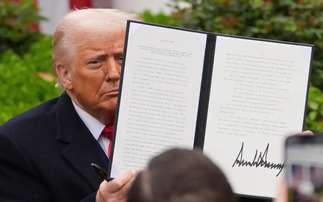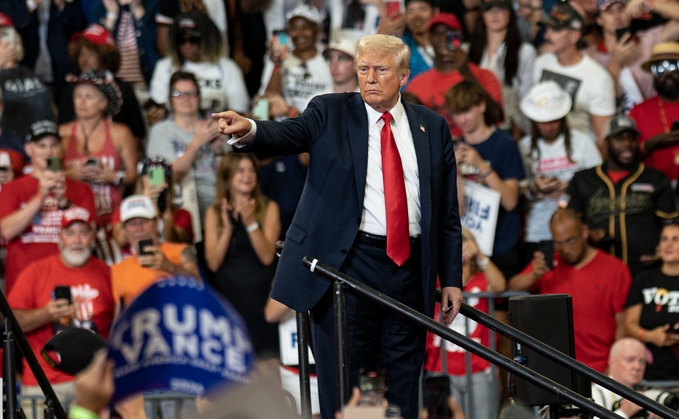
President Trump (pictured) utilised the 1974 Trade Act to reimpose temporary blanket tariffs of 10%, subsequently hiking them to 15% on Saturday (21 February). Credit: Shutterstock
Global markets are expected to "muddle through" the heightened uncertainty caused by US President Donald Trump’s latest tariff manoeuvres, after the US Supreme Court struck down his 'Liberation Day' regime.
Initial exuberance over the US Supreme Court's decision to declare Trump's tariffs under the International Emergency Economic Powers Act (IEEPA) as unconstitutional on Friday (20 February) made way for uncertainty, as the president utilised the 1974 Trade Act to reimpose temporary global blanket tariffs of 10%.
Fed holds rates as markets 'remain nervous' about central bank's independence
On Saturday (21 February), Trump took to social media to further announce he was increasing the tariff rate to 15%, "effective immediately".
Susannah Streeter, chief investment strategist at Wealth Club, said bilateral deals reached through tortuous negotiations have been thrown up in the air again, with countries preparing to retaliate.
"The European Union [is] looking set to halt the ratification of a deal with the US and India [is] also postponing its negotiations to finalise an agreement. Instead of taking a big step forward, global trade has taken two steps back," she explained.
The imposition of a 15% global levy has created yet another cliff edge, added AJ Bell investment director Russ Mould, after investors had absorbed the trade policies announced by the Trump administration last year.
Market reaction over the weekend's tariff upheaval thus far, however, has been muted.
The FTSE 100 was trading roughly flat at the time of reporting, according to data from MarketWatch, with Mould noting it had benefitted from its precious metals allocation as gold prices moved higher amid the uncertainty.
The price of gold was up 1.7% to over $5,160, while silver shot up by close to 5% to over $86.5.
The CAC 40 was also flat, while the DAX retreated by 0.5% and the STOXX Europe 600 was down 0.3%.
Rathbones' David Coombs: Why we are not worried about the US
Meanwhile, over in the US, the dollar weakened against a basket of currencies and US futures pointed to a lower open on Wall Street, as traders weighed the possible impact on the US deficit, according to Mould.
Markets were already pricing in a restructuring of trade policy along current lines, eToro global market analyst Lale Akoner said, with the Supreme Court's ruling accelerating that transition rather than derailing it.
"Importantly, other authorities such as Section 232 and Section 301 remain available, and the administration has made clear it intends to use them. That reinforces the idea that tariffs are likely to be recalibrated, not eliminated," she continued.
The near-term risk, however, is uncertainty, Akoner explained: "Shifting legal foundations could dampen activity temporarily. However, if the outcome is a more predictable tariff structure, equities may ultimately benefit."
Andrew Ells, head of risk arb and hedge fund sales at Peel Hunt, also outlined several potential benefits.
Fed remains hawkish on rates with prospect of hikes not off the table
He said the overall effective tariff for consumers now appears lower than before, falling from 16% to 9.1% after the IEEPA tariffs were struck down before rising to 13.7% after the Section 122 tariffs were imposed, according to the Yale Budget Lab.
"The ruling also opens the doors to billions of dollars in refunds for importers who paid under the IEEPA tariffs, sparking potential legal battles and administrative chaos but also transferring back profits and revenues which can support US domestic demand," Ells continued.
Additionally, Trump's Republicans only hold a narrow majority in Congress, Ells noted, so it is not a forgone conclusion that it will vote to extend the next round of tariffs beyond 150 days.
While tariff uncertainty – alongside US-Iran tensions – represent flashpoints that could test global financial market resilience, the Peel Hunt head added: "Our base case remains that these problems, like the many others during Trump's second term so far, will come and go and markets will muddle through."