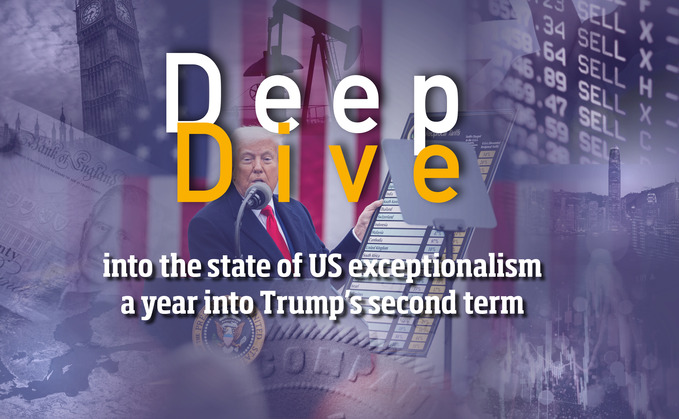
Investors are beginning to diversify away from the US.
Almost a year on since US President Donald Trump was sworn into the Oval Office for the second time, markets have become increasingly accustomed to the chaos that has so far characterised his administration.
"We have entered a regime of controlled disorder, which is redefining investment opportunities," said Monica Defend, head of the Amundi Investment Institute.
Risks have stemmed from a combination of structurally higher inflation and growing geopolitical tensions, which have added to fiscal vulnerabilities, she noted.
Trump's Maduro move and the 'Donroe doctrine' reinvigorating defence stocks
But after investors shook off most of what Trump's first 12 months threw at them - from tariffs and uncertainty around defence, to the recent military intervention in Venezuela - US exceptionalism, while dented, remained fundamental to investment decisions.
According to Alexandra Morris, head of SKAGEN: "The end of American exceptionalism proclaimed by some was misplaced."
With central banks easing monetary policy globally and US dollar weakness bolstering the prospects of regional and emerging markets, Morris said she expects the US to "remain strong and AI to remain a key market growth engine".
It will be up to investors to "look beyond the obvious concentrated winners" to generate alpha as the year progresses, argued the SKAGEN head.
While US technology companies continued to post impressive results in 2025, investors looked to diversify, leading to strong returns for the FTSE 100 compared to the S&P 500.
According to data from MarketWatch, the FTSE 100 grew by 21.5% in 2025 compared to the 16% returned by the S&P 500.
Oil spike and Trump promises not enough for managers to make long-term oil bet
"We hear, anecdotally, that there is more interest in European assets. This might be to diversify away from US dollar risk or for the underlying regional benefits of investing in Europe," said Anita Rana, principal at Hamilton Lane.
The US dollar weakened during Trump's first 12 months in charge, with the greenback down 9.7% against a basket of other currencies over the last year.
"The geopolitical picture and its impact on global economies over the past year has forced investors to review the risks in their portfolio, which may now include increased currency, regional and tariff risk. Those considerations might continue to create interest and opportunity in Europe," added Rana.
Amundi's Defend concurred. She explained that while US exceptionalism remains important due to the country's liquid capital markets, research and development abilities, and shareholder friendly ecosystem, "these strengths remain, but are not as pronounced".
With a greater focus on the US' high debt burden, American assets have become "less central in the allocation of global portfolios", Defend said.
"Not only have the dollar and Treasuries lost some of their appeal as safe havens, but the relative returns of US assets have lessened."
A pivot away from the US
In some cases, the Trump-induced tumult has caused more than a mere focus on diversification.
Jean-Charles Sambor, head of emerging market (EM) debt at TT International, said that during the aftermath of Trump's election, there was a view that the dollar would strengthen and EM currencies would weaken.
Instead, "all these views have proven to be incorrect", as the dollar weakened, Treasuries spiked and US equities fell behind international competitors.
"These moves appear to signal a broader loss of investor confidence in US governance, with the market no longer seen as the default safe haven," said Sambor.
He argued "this may be the beginning of a period of emerging market exceptionalism", due to more fiscal and liquidity headroom in EMs than developed markets, and significantly lower leverage.
Asset allocation
Amundi's Defend echoed Sambor with her firm's asset allocation. Due to the relative price of US assets compared to others, she said there is "little value in the US", with a more positive view towards Europe and the UK instead.
Prospect of pro-Trump Fed raises investors concerns for US economy
"We like EM bonds in hard currency and local currency bonds in Central and Eastern Europe, Middle East and Africa (CEEMA), as well as select Asian (ex-Japan) and LatAm countries," she said.
SKAGEN has also pivoted towards EM slightly, but through the artificial intelligence investment theme. While it still owns Alphabet and Microsoft, Morris explained it has EM AI exposure through Alibaba, Samsung Electronics and TSMC, where valuations are "less stretched".
"Strong earnings growth should mean EMs generally have further to run, while small caps remain undervalued and should benefit from rising M&A activity," she added.
Looking at investment opportunities outside the US, Hamilton Lane's Rana said demand has been growing. "In recent years, Europe and Asia have seen significant net asset value growth", but she highlighted that private markets NAV "is still dominated by North America".
Amid uncertainty about the future, Amundi's Defend added: "The US will remain a wildcard in the years ahead. The uncertainty over the US political outlook and high debt levels will contrast with ongoing spending in AI and deregulation efforts."
Share
Related Topics
-
US

-
Markets
-
Currencies
-
Economics
-
Global
-
Emerging markets
-
Deep Dive
-
Emerging Markets
-
Donald Trump
-
Markets
-
US dollar
-
currencies
-
Economics
-
Global
-
Monica Defend
-
Amundi Investment Institute
-
Alexandra Morris
-
SKAGEN
-
FTSE 100
-
S&P 500
-
Hamilton Lane
-
Anita Rana
-
Jean-Charles Sambor
-
TT International Asset Management
-
IW Asia