Jourdan, who ran the VCT when it was under Amati's management for over 20-years, posited: 'How one-sided is it ok for a circular to be?'
Shareholders have not been presented with anything out of keeping with investment trust proxy voting precedent, according to the board of Maven Renovar VCT, amid claims from the requisitioning party that the board has put an unfair or even unlawful document to its clients.
An ongoing tussle for power between the board of the venture capital trust and a group of requisitioners, spearheaded by former manager of the VCT and Amati CEO Paul Jourdan, has seen each side trade blows in recent weeks.
Maven was hired as the VCT's manager in December 2024, in turn displacing former manager Amati and Jourdan, but has been subject to criticism from a group of requisitioners who make up just over 5% of the trust's issued share capital.
Having accused the board last week of burying key information in a circular distributed to shareholders, Jourdan has again questioned the intentions of the board via a LinkedIn post and in an open letter published in FT Adviser.
According to the former manager, shareholders "have been sent a 39-page circular by the current board, urging them, in bold orange letters on 12 of the first 25 pages, which way to vote in forthcoming general meetings".
Jourdan argued that "because the orange words jump off the page with their colour, they look like instructions, not recommendations".
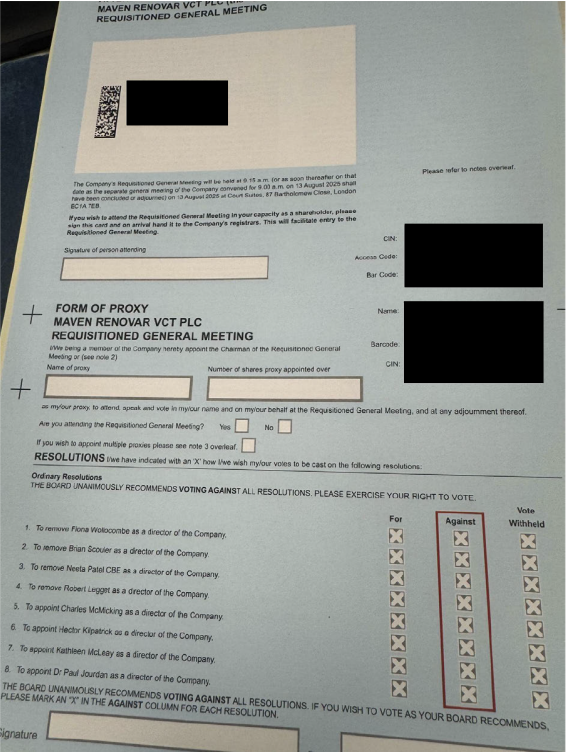
The proxy voting forms also had large red borders surrounding the boxes that correspond to the way the board has urged shareholders to vote, he highlighted.
Referring to the previous letter co-signed by his fellow requisitioners, Jourdan said: "The circular buries the text which explains the key issues shareholders are being asked to vote on, tucking this information away on page 29, and making no suggestion anywhere that shareholders should read it."
He continued: "Given how repetitive the document is up to this point, and how pointedly one-sided and unbalanced its arguments and accusations are, you could be forgiven for having given up reading it long before this point. Even the most seasoned investors and journalists have failed to find the text from the requisitioners. It is effectively buried."
The Amati CEO claimed the proxy voting form "is a clear attempt to stop investors from understanding what requisitioners are asking them to consider".
One shareholder, who chose to remain anonymous, went so far as to worry that this form was unlawful, citing concerns that it has forced the board's message. It is worth noting that this shareholder planned to vote in favour of Jourdan and co's agenda, having been a long-term shareholder under Amati.
But, Investment Week confirmed that this was not the case and that the Maven Renovar board acted in line with current guidelines.
Roger Lawson, a former director and deputy chair at ShareSoc, a non-profit campaigning organisation that represents and supports individual investors who invest in the UK companies, explained that the board is "allowed to do it…but it is not best practice".
Lawson is also a longstanding shareholder in the Maven, formerly Amati, VCT strategy, and said he and his wife had filled out their voting forms in favour of the board's proposal, stating he was "happy for Maven to take over" as it was "time for a change".
Maven Renovar blasted for manager shakeup as Amati removal 'a bad outcome for the VCT market'
In the wake of Jourdan's public questioning, the Maven Renovar board has stood firm in its conviction that it has acted in line with precedent set by boards of other investment trusts.
"The structure of the circular is entirely consistent with the standard approach used in cases of requisitioned general meetings, as has been seen in many recent examples. Indeed, the rights and obligations of companies and their shareholders in this context are well established as a matter of company law," the board told Investment Week.
It added that the board was "surprised by the complaints of the requisitioners and have attempted to engage with them on this point – though we have not yet had a response".
"Nothing has been concealed and we reject the notion that the document is in any way misleading. Our circular was designed to serve the interests of all shareholders, rather than any particular minority, and we encourage shareholders to review the full circular carefully ahead of the vote," it added.
Investment Week understands that there is no best practice guidance on what a proxy voting form should look like, with no mention of how boards must present voting cards in the Venture Capital Trust Regulations 1995.
The job of an investment trust board is to act and present what it deems to be in the best interests of shareholders and to enact this with clarity; it does not have to act impartially.
Earlier this year, during the Saba Capital Management investment trust saga which rocked the industry, many of the trusts' boards put out statements and forms akin to the one provided by the Maven board in their communication with clients.
Similar red boxes, bold lettering, and arrows pointing towards the interests of the boards were distributed by trusts such as Edinburgh Worldwide, Baillie Gifford US Growth and European Smaller Companies trust, among others.
In his post on LinkedIn, Jourdan, who ran the VCT when it was under Amati's management for over 20-years, posited: "How one-sided is it ok for a circular to be?"
'Shareholders deserve better': Maven Renovar urges clients against Amati's proposals
Investment Week spoke with shareholders who said they would have preferred more consultation from the Maven Renovar board but revealed they would vote with the board due to the tax benefits provided by the special dividends proposed by it.
The board of Maven Renovar noted a low turnout of less than 15% of voting shares at the annual general meeting earlier this year.
Nick Britton, research and content director at the Association of Investment Companies, said: "It is really important that shareholders come out to vote."